Canadian intelligence services
Guantanamo DiaryCanadian intelligence services are presented in Mohamedou Ould Slahi’s account not through an institutional profile, but through the consequences of their attention to him during his short stay in Canada. The account describes intercepted conversations shared with United States officials in edited form, surveillance that Slahi believed included an attempt to install hidden cameras, and the later use of his Canadian associations as grounds for suspicion. Its central tension is between the thinness of the information as Slahi understood it and the weight later placed upon it.
A brief Canadian stay and a widening suspicion
Slahi had lived in Germany for about twelve years before moving to Montreal in November 1999. He had arrived in Canada less than a month before Ahmed Ressam, who had been based in Montreal, was arrested with explosives while entering the United States in connection with the Millennium Plot. Ressam had left the city before Slahi arrived. The proximity of these events supplies context for the suspicions described in the diary, but does not itself establish that Canadian intelligence had evidence linking Slahi to Ressam or to the plot.
Slahi says Canadian officials cited people they had seen him with, places of worship he had visited, and telephone conversations they had intercepted. In his account, the material supplied to American officials consisted of selected, edited passages rather than complete conversations in their original form. He objected that excerpts taken from a larger exchange could be made to suggest meanings that the whole conversation would not support. He argued that the Canadian authorities should either have withheld private conversations or provided them intact, rather than offering fragments for interpretation.
The recurring phrase and the camera attempt
Among the excerpts that reached American interrogators, two ordinary words—tea and sugar—became an enduring focus. Slahi recalled being asked repeatedly what he meant by them, and said the questioning continued for more than four years. The phrase’s persistence, set against his assertion that the underlying Canadian material contained little of substance, illustrates how a small fragment could become a durable object of suspicion once passed from one security service to another.
Slahi also connected Canadian intelligence’s attention to the political pressure following the Millennium Plot. He believed Canadian officials wanted him to be a criminal so they could answer criticism that an explosives-carrying suspect had passed from Canada into the United States. He described the United States as blaming Canada for serving as a preparation ground for attacks, and interpreted the surveillance of people considered suspicious as an effort to relieve that pressure. This is Slahi’s explanation of the agency’s actions and motives, not an independently established account of internal Canadian decision-making.
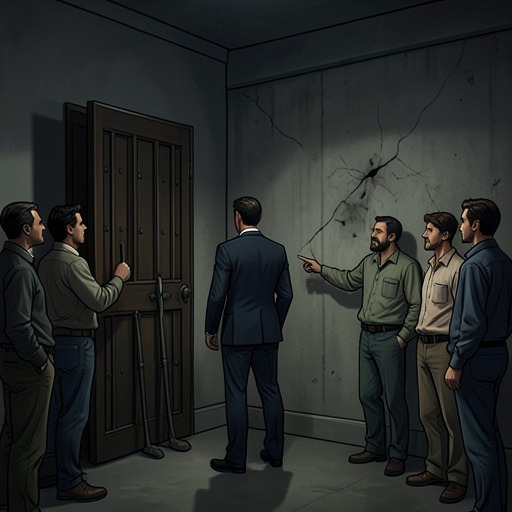
One surveillance episode became visible to Slahi and his roommate when the roommate heard noises and watched a neighboring occupant drill through a wall. According to Slahi, the neighbor looked through the opening and made eye contact with the roommate. Slahi chose not to use the apartment telephone; he went outside to call emergency services from a public phone. When two police officers arrived, he reported that the neighbor had drilled holes without permission and asked them to address what he regarded as trespass and invasion of privacy. The officers advised filling the holes with caulk. Slahi took their response as evidence that the incident was not being handled as an ordinary complaint, and he and his roommate later made fun of the apparent surveillance plan. The episode records his interpretation and the response he recounts; it does not establish the identity or institutional affiliation of the person drilling.
From Canadian information to a wider case
Slahi contrasted the Canadian material with his years in Germany: he said that twelve years there had yielded no incriminating information, while less than two months in Canada were later represented to American officials as having produced a great deal. He also insisted that his activities in Canada were not criminal. In his account, the information nevertheless travelled beyond Canada and was interpreted by Mauritanian and United States authorities in ways that supported the theory that he was the mastermind of the Millennium Plot.
The consequences appear in the interrogation that followed. A Mauritanian interrogator questioned Slahi about what he had done in Canada; Slahi says his answers were repeated denials, which did not persuade the authorities. He believed that his failure to give a fuller account of his earlier time in Afghanistan made him seem guilty, and that he then tried to fill that gap. He also recalled the pressure of being told to admit wrongdoing or face a special team, while fearing that a filmed confession might be broadcast on national television. The Canadian material thus enters the narrative as one part of a larger chain: suspicion generated or sustained by fragmentary information could be carried into another country’s questioning and acquire consequences far beyond the original Canadian surveillance.
What the account establishes—and leaves uncertain
The book’s editorial framing cautions against treating every interpretation of censored material as settled fact. Its annotations draw on context within the manuscript and publicly available sources, including declassified government documents and official investigations, but explicitly do not attempt to reconstruct classified text. That distinction matters here: Slahi’s account gives detailed grounds for understanding how he perceived Canadian intelligence’s role, while the cited passages do not supply an agency record confirming the full content, selection process, or purpose of the intercepted conversations.
The organization’s significance in this account therefore lies less in a documented description of its structure than in the movement of information attributed to it. Edited communications, reported surveillance, and suspicions about Slahi’s associations cross institutional and national boundaries; after that movement, the phrase tea and sugar becomes a recurring interrogation topic and the Canadian period becomes part of a much larger accusation. The narrative keeps the uncertainty visible even as it shows the lasting force that an unverified or selectively presented fragment can acquire.